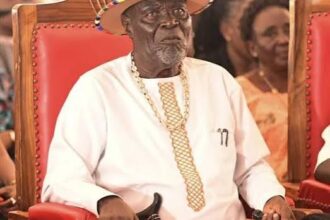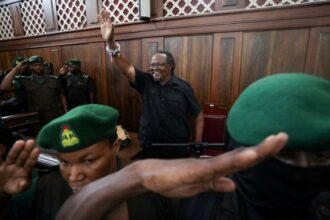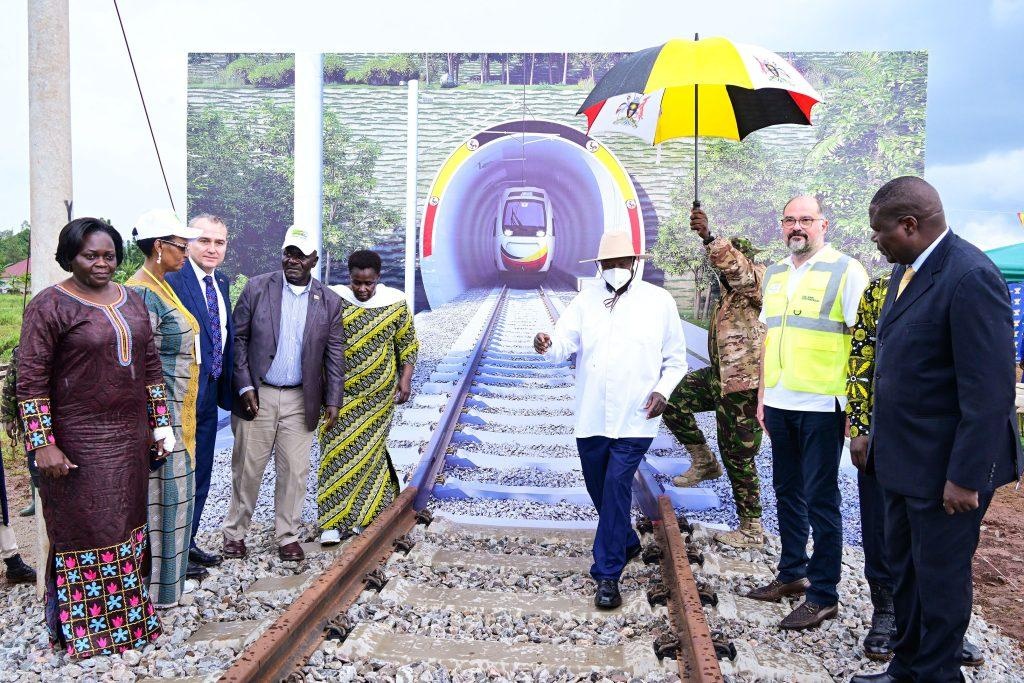
President Museveni leads officials in inspecting a section of the Standard Gauge Railway (SGR) project during its launch in Tororo, eastern Uganda. The 272-kilometre Malaba-Kampala line is expected to connect Uganda to Kenya’s railway network and improve regional freight and passenger transport.
By Metro News Reporter
Uganda’s Chief of Defence Forces, General Muhoozi Kainerugaba, has announced renewed government backing for Turkish construction company Yapı Merkezi to build the country’s long-delayed Standard Gauge Railway (SGR), months after declaring that its contract had been cancelled.
In a statement posted on X on Friday, Kainerugaba said the decision had been made under the direction of President Yoweri Museveni, authorising the Turkish firm to implement the first phase of the railway linking Malaba, on the Kenyan border, to the capital Kampala.
“Under the direction and instructions of Mzee Museveni, I approve the Turkish company Yapi Merkezi to implement the 1st Phase of the SGR. From Malaba to Kampala,” he said.
“All departments of government are instructed to quickly implement this directive.”
The announcement appears to reverse Kainerugaba’s June 16 declaration that Uganda had cancelled its agreement with the Turkish contractor and would seek another company to undertake the multibillion-dollar project.
However, his latest statement did not provide details of a revised contract, financing arrangements or a new construction timetable. Neither the Ministry of Works and Transport nor Yapı Merkezi had immediately issued a formal confirmation of the reported reinstatement.
The development comes as Uganda seeks to advance a railway project that has experienced years of delays, largely over difficulties securing financing and finalising implementation arrangements.
Uganda signed a 2.7-billion-euro (about $3 billion) engineering, procurement and construction agreement with Yapı Merkezi in October 2024 for the construction of the approximately 272-kilometre Malaba-Kampala section.
Museveni launched the project in Tororo in November 2024, with the railway expected to take 48 months to complete once full construction begins.
The electric railway is designed to connect Kampala with Malaba, where it will link to Kenya’s SGR network, providing landlocked Uganda with a rail connection to the Port of Mombasa, a major gateway for regional imports and exports.
The project is expected to strengthen the Northern Corridor, reduce reliance on road freight and lower the cost of transporting goods between the Kenyan coast and Uganda.
Its progress, however, has been constrained by the challenge of assembling the estimated 2.7-billion-euro financing package.
Uganda initially pursued a partnership with China’s China Harbour Engineering Company, signing an agreement in 2015 under which the company was expected to help secure Chinese government financing.
After years of unsuccessful negotiations, the government terminated that arrangement in 2023 and turned to Yapı Merkezi, which is also involved in railway construction in neighbouring Tanzania.
The Turkish contractor was subsequently allowed to undertake preliminary activities under a limited notice to proceed arrangement while the government pursued financing for the main construction works.
In April 2026, Uganda appointed Citibank to help mobilise funds for the railway, while pursuing support from development finance institutions and export credit agencies.
The Islamic Development Bank approved financing of about 650.75 million euros in June, while the African Development Bank indicated a tentative allocation of approximately $650 million. The OPEC Fund has also been considering additional financing.
Despite these developments, financial closure — the point at which the financing package is fully secured and available for implementation — has remained a major hurdle.
The latest announcement therefore raises questions about whether the government has resolved the contractual uncertainty and secured sufficient funding to move the project into full-scale construction.
The railway also carries considerable regional significance for Kenya, which is extending its SGR network westwards from Naivasha through Kisumu to Malaba.
Kenya and Uganda have been coordinating their respective railway plans to establish a continuous standard-gauge rail connection between Mombasa and Kampala.
Kenya’s planned Naivasha-Kisumu-Malaba extension covers approximately 369 kilometres. Once both sections are completed and operational, the connection could improve freight movement along the Northern Corridor and strengthen trade with other landlocked economies in the region.