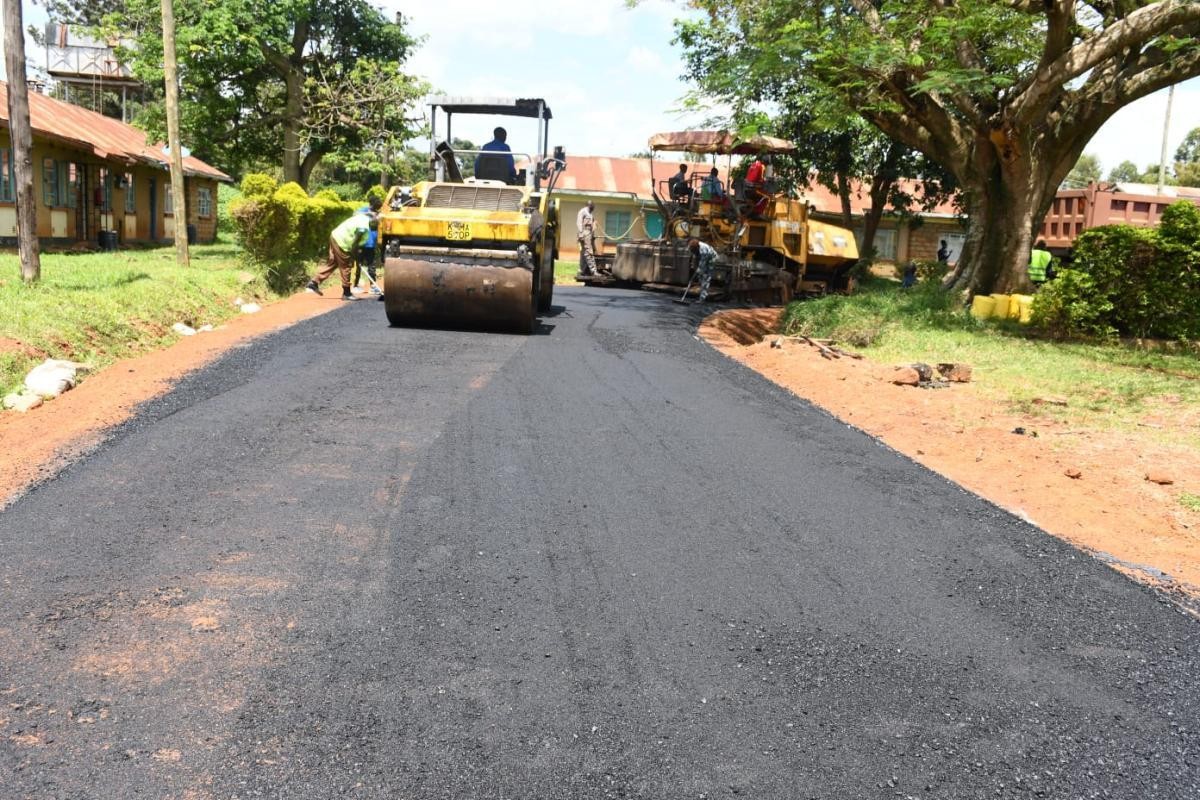
Road construction works in Busia County, where Weihai Construction Group has secured a Sh3.2 billion contract to upgrade three roads.
By Metro News Reporter
A Sh3.2 billion road contract awarded to a Chinese construction company previously sanctioned over fraudulent practices on Kenyan infrastructure projects has renewed attention on the safeguards governing public procurement and the standards expected of firms handling taxpayer-funded works.
Weihai Construction Group Company Limited has been selected by the Kenya Rural Roads Authority (KeRRA) to upgrade and maintain three roads in Busia County, marking its return to publicly funded infrastructure projects after completing a 35-month debarment imposed by the African Development Bank (AfDB).
The contract, awarded on July 6, covers the Butula–Nambale–Amukura, Amukura–Machakusi and Kotur–Kocholia roads. The routes are expected to be upgraded to bitumen standards, improving connections between communities, markets and essential services in the county.
The award comes as the government steps up road construction and rehabilitation, with infrastructure investment increasingly viewed as a way to lower transport costs, connect rural producers to markets and support trade across the country.
But the appointment also raises a wider question: how effectively do public agencies assess the compliance records and performance of contractors when they return to the market after serving sanctions?
The AfDB imposed a 35-month debarment on Weihai, effective November 19, 2021, after its investigations established that the company had engaged in fraudulent practices in three Kenyan infrastructure programmes.
They included the Kenol-Sagana-Marua Highway Improvement Project, the Nairobi Rivers Basin Rehabilitation and Restoration Programme and the Towns Sustainable Water Supply and Sanitation Programme.
The sanction meant the company could not participate in projects financed by the AfDB during the exclusion period.
Under a mutual enforcement arrangement among several multilateral development lenders, the penalty also had implications for its eligibility to work on projects financed by other participating institutions.
When announcing the settlement that led to the sanction, the AfDB said the company’s return to bank-financed projects would depend on implementing an integrity compliance programme that met the institution’s requirements.
Whether the company has fulfilled those conditions remains an important point of scrutiny. Attempts to obtain its position on compliance with the requirements were unsuccessful, according to the report.
The distinction is significant: the expiry of a debarment does not, by itself, establish that a contractor has met every condition attached to its return to publicly financed work. Procuring agencies and project owners still have a responsibility to apply their own due diligence and enforce contract requirements.
KeRRA records also list Weihai as the contractor for other road projects, including the Sh2.18 billion Soy-Serekea-Kilimani-Turbo and associated roads project and the Sh722 million Narumoru-Ngaring’iru-Nairutia Ngobit road project.
The company’s latest award comes amid a broader expansion in road procurement. KeRRA has issued contracts worth nearly three times the Sh6.09 billion recorded across 967 contracts in the 12 months to June, pointing to a faster pace of project awards ahead of the 2027 General Election.
The scale of the procurement drive makes transparency and oversight particularly important. As more contracts are issued, the quality of tender evaluation, supervision of construction and enforcement of integrity standards will help determine whether the spending produces durable infrastructure.
For communities in Busia, the immediate measure of success will be practical: roads that remain usable throughout the year, shorter journeys to markets and public services, and lower costs for moving agricultural produce and other goods.
For the government, however, the challenge extends beyond awarding contracts and starting construction. It must ensure that contractors deliver work to specification, meet agreed timelines and remain accountable for the use of public funds.
The case also highlights the role of development finance institutions in setting standards for infrastructure procurement. The AfDB’s sanctions framework is designed to protect projects against misconduct, while its cooperation with other multilateral lenders allows penalties to carry consequences beyond a single institution’s portfolio.
Several other companies with links to Kenya were still listed in the AfDB’s sanctions register as of November 3, 2026. They include Esiko Kenya Enterprises, Tetralink Taylor & Associates East Africa and Jiangxi Transportation Engineering Group.
Such measures are intended to deter fraud, corruption, collusion and other forms of misconduct that can undermine public projects. Their effectiveness, however, also depends on how consistently contracting authorities apply due diligence and monitor companies after awards have been made.
As Kenya expands its road network to support domestic commerce and regional trade, the next test will be ensuring that the drive to build faster does not come at the expense of accountability. The value of a road contract will ultimately be judged not only by its price or the kilometres delivered, but also by the quality, reliability and public benefit of the infrastructure it produces.
Editorial note: I have described Weihai as a company previously debarred by the AfDB, rather than simply calling it “blacklisted”. The sanction was imposed by a specific development-finance institution for a defined period; that distinction is important.
The AfDB also made the company’s return to its own projects conditional on an integrity compliance programme. The available report does not establish whether Weihai has met that condition, so the rewrite leaves it as an open question rather than presenting non-compliance as fact.
The key forward-looking thread is procurement accountability: the Busia roads matter, but so does whether Kenya’s contracting agencies can demonstrate that past misconduct is properly considered when public contracts are awarded.