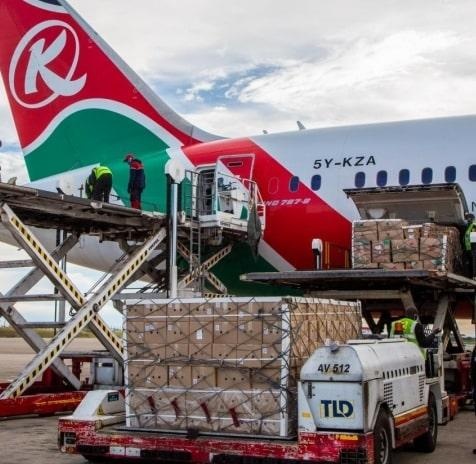
Cargo is loaded onto a freighter at Jomo Kenyatta International Airport in Nairobi. African airlines increased cargo capacity by 14 per cent year-on-year in August 2026, even as demand grew by 3 per cent, according to IATA/File
By Kennedy Otieno
Africa’s airlines recorded the fastest expansion in cargo capacity globally in August, but demand failed to keep pace, raising concerns over aircraft utilization at a time when soaring fuel prices are piling pressure on operating costs.
The latest air cargo market analysis by the International Air Transport Association (IATA) shows that cargo capacity among African carriers jumped 14 percent year-on-year in August, while demand grew by just 3 percent.
The imbalance pushed Africa’s cargo load factor down 3.9 percentage points to 36.5 percent, the sharpest decline among the regions tracked by IATA, indicating that a smaller share of available freight capacity was being used.
Africa’s performance contrasts with the global market, where freight demand is growing faster than available capacity.
Worldwide air cargo demand, measured in cargo tonne-kilometres (CTK), increased by 4.4 percent compared with August last year, while capacity declined marginally by 0.1 percent.
International cargo traffic expanded by an even stronger 5.3 percent, helping lift the global cargo load factor by two percentage points to 46 percent.
North America and Asia-Pacific accounted for nearly three-quarters of the additional global cargo traffic, jointly generating 72.3 percent of worldwide growth.
Capacity outpaces demand
Africa stood out as airlines increased available freight space at a much faster rate than their counterparts elsewhere.
IATA said capacity growth on the continent accelerated by 9.5 percentage points to 14 percent, even as capacity momentum weakened across most other regions.
Europe and North America went in the opposite direction, cutting capacity by 3.5 percent and 2.5 percent respectively.
Together, carriers in the two regions removed more than 756 million available cargo tonne-kilometres from the market.
The cuts helped carriers in those markets fill a larger proportion of available freight space. Europe recorded the world’s highest regional cargo load factor at 53 percent, followed by Asia-Pacific at 48.6 percent, the Middle East at 43.1 percent and North America at 42 percent.
Africa’s load factor stood at 36.5 percent.
The August figures, however, mask a stronger performance over the first eight months of the year.
African carriers recorded 8.5 percent growth in cargo demand between January and August, compared with the same period last year, while capacity increased by just 2.2 percent.
That pushed the continent’s year-to-date load factor up 2.6 percentage points to 45 percent, suggesting the sharp August capacity expansion is a more recent development rather than a prolonged weakness in the African cargo market.
The additional capacity could give African exporters greater access to international markets, particularly for high-value and time-sensitive products.
But airlines will need freight volumes to rise sufficiently to absorb the extra space if the expansion is to translate into stronger returns.
Fuel costs squeeze margins
The capacity increase comes as airlines grapple with sharply higher fuel costs.
Jet fuel rose to $157 (Sh20,245) a barrel in August, its highest level in three months and the highest August reading in 13 years.
Prices increased 8.3 per cent from July and were 79.2 percent higher than a year earlier, according to IATA.
Brent crude averaged $90.80 (Sh11,713) per barrel, up 8.9 percent month-on-month, while the jet fuel refining margin climbed to $65.80 (Sh8,488) a barrel.
IATA attributed the pressure partly to disruptions to Persian Gulf supplies, lower Russian exports and competition from diesel production, which tightened supplies of middle-distillate fuels.
Cargo rates are providing airlines with some cushion. Global air cargo yields increased 1.3 percent from July and stood 24.9 percent above their level a year earlier, extending annual double-digit growth to a sixth consecutive month.
The broader trade environment also remains supportive.
The global manufacturing output purchasing managers’ index rose to 53.0, while the new export orders index increased to 51.4. A reading above 50 indicates expansion.
Global merchandise trade volumes were also 6 percent higher than a year earlier, marking the 33rd consecutive month of annual growth.